Artist Leena Nammari has chosen the Arabic word Haneen as the focal point of her presentation in this exhibition; Haneen encompasses the English-language words of heart-felt longing, belonging-at-distance, homesickness and feeling accepted; sentiments which are universally experienced if not easily expressed in the English language. The three works on show here express Leena’s sense of love for, and being bound to her occupied-homeland of Palestine as she lives her life elsewhere, in exile.
The work 1,000 Protections is made up of more than one thousand (please do count them!) unique stoneware discs each of which is lovingly shaped/formed, hand-painted, glazed and kiln-fired by Leena. Known throughout the world, the Mediterranean evil eye is an ancient talisman of protection; a small but powerful object shielding people against evil and misfortune. Like the Gaelic, the phrase “A 1,000…” is used by Arabic cultures to express an intensity of feeling, so in sharing one thousand pieces of her work with us, Leena is offering us her act of wellbeing and protection from her culture to us.
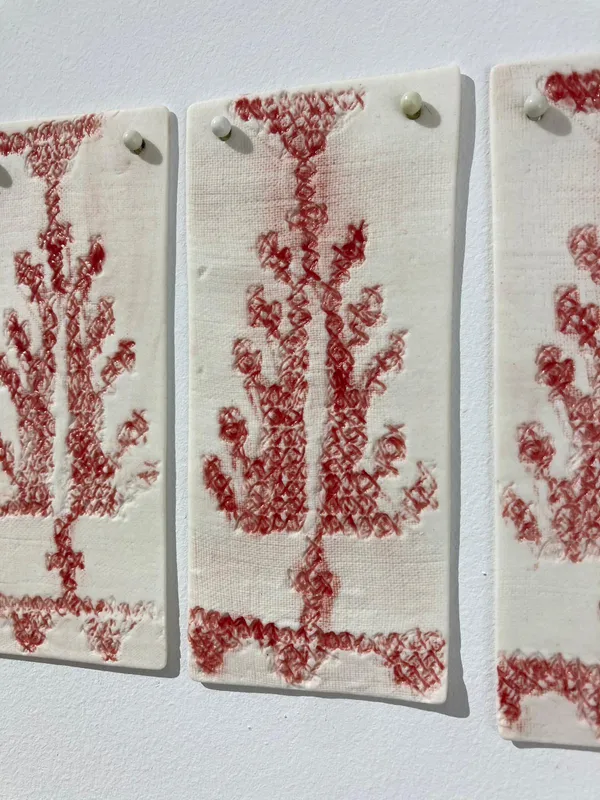
Entitled Absence Does Not Mean Forgetting, the rows of plaques coloured blood-red shown here represent the seven decades of ten years which have passed since Palestine began its struggle in 1948 to free itself from occupation and return the right to peaceful belonging to each of its citizens. This installation is just one part of this organically evolving work which Leena initially made in 2002 to document the erasure of 418 villages during the conflict.
The version of this artwork currently on show at the V&A Dundee presents 626 plaques, recording the number of villages recorded as erased by 2025. As the erasures of villages continues, Leena also continues to increase the number of red plaques.
48 Scrolling Hills indicates the year (1948) that Leena’s homeland became occupied, and that despite invasion, the terrain remains. Each scroll carries an image of the view from the Ramallah hills towards Gaza, (about the same distance from Cruachan to Oban), with Arabic and English texts reminding us that we do not actually own the lands that we live on and fight over, and that these lands bear witness, quietly and stoically, to the consequences of human custodianship.